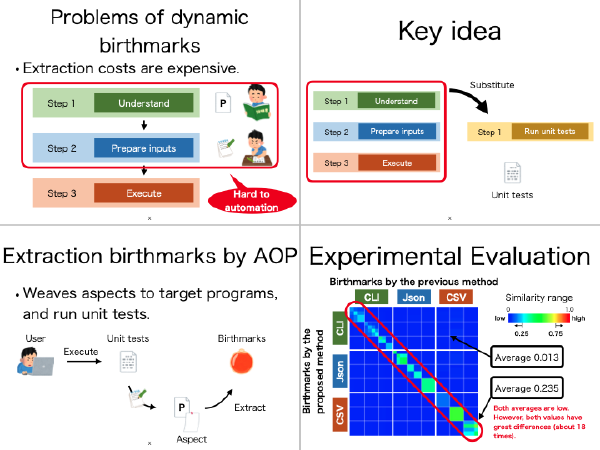
:speaking_head: Overview # The software birthmark methods are proposed to find the stolen software from the huge number of suspects. The software birthmark methods are classified into two manners, static and dynamic manners. Different from the static birthmarks, dynamic birthmarks require inputs since they base on runtime behaviors. Also, the dynamic birthmark varies depending on the inputs, therefore, it is difficult to extract beforehand. Hence the extraction cost of the dynamic birthmarks is generally high than the static birthmarks. This paper focuses on unit test codes in a project in order to extract the dynamic birthmarks beforehand, and reduce the extraction cost. The experiments evaluated the credibility and resilience performance of the birthmarks. The performance evaluation showed good results, the similarities were greater than 0.8 between most recent two versions of the same products, and were under 0.355 among different projects. In the cost evaluation, the proposed method can reduce the extraction cost of dynamic birthmarks.
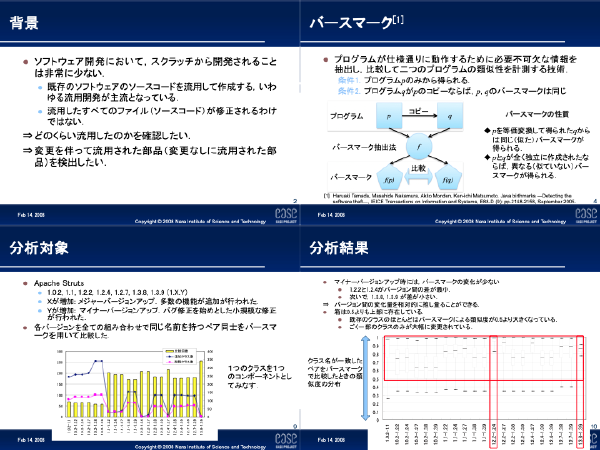
:speaking_head: Overview # This research topics shows applications of software birthmarks. In our publications, we try to classify the programs using extracted software birthmarks. Because, we believe that the birthmarks shows the functionalities of the programs.
:books: Publications # 牛窓 朋義, 門田 暁人, 玉田 春昭, 松本 健一, “使用クラスに基づくソフトウェアの機能面からの分類”, 信学技報 ソフトウェアサイエンス研究会, Vol.SS2009-17, pp.31-36, August 2009. 玉田 春昭,森崎 修司,門田 暁人,松本 健一,”バースマークを用いたソフトウェア拡張開発での流用度合いの測定”,情報処理学会第70回全国大会,pp.5-399-400, March 2008. Takesi Kakimoto, Akito Monden, Yasutaka Kamei, Haruaki Tamada, Masateru Tsunoda, and Ken-ichi Matsumoto, “Using Software Birthmarks to Identify Similar Classes and Major Functionalities,” In Proc. the 3rd International Workshop on Mining Software Repositories (MSR 2006), pp.171-172, May 2006. (Shanghai, China) Link dl.acm.org :mag_right: Related Research Topics # Concept of Software Birthmarks Dynamic Software Birthmarks Fast comparisons of the birthmarks :handshake: Collaborators # A. Monden@Software mesurement and analytics laboratory, Okayama University
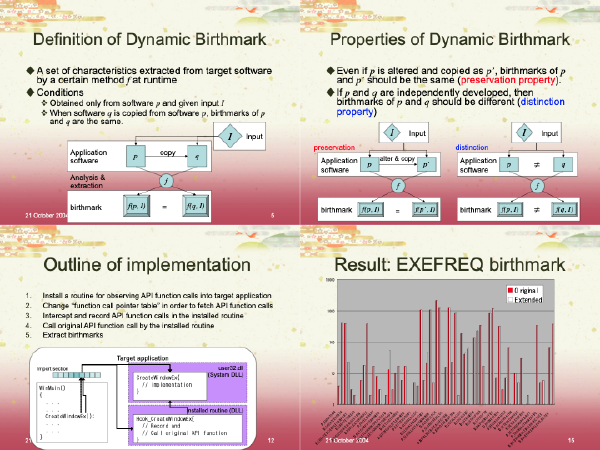
:speaking_head: Overview # This paper presents a technique of dynamic software birthmarks to support efficient detection of software theft. A dynamic birthmark $f(p, I)$ is a set of unique and native characteristics of a program $p$, obtained by executing $p$ with a given input $I$. For a pair of software $p$ and $q$, if $f(p, I) = f(q, I)$ holds, $q$ is suspected as a copy of $p$. In this paper, we propose two kinds of dynamic birthmarks, EXESEQ and EXEFREQ which use execution order and frequency distribution of runtime API Calls. In the first experiment, we applied the proposed birthmarks to the same-purpose applications. As a result, it was shown that an application and its extended version have quite similar birthmarks, and that the applications that are independently implemented possess significantly different birthmarks. The second experiment showed that the proposed birthmarks achieve the strong resilience against the usage of different compilers and optimizations.
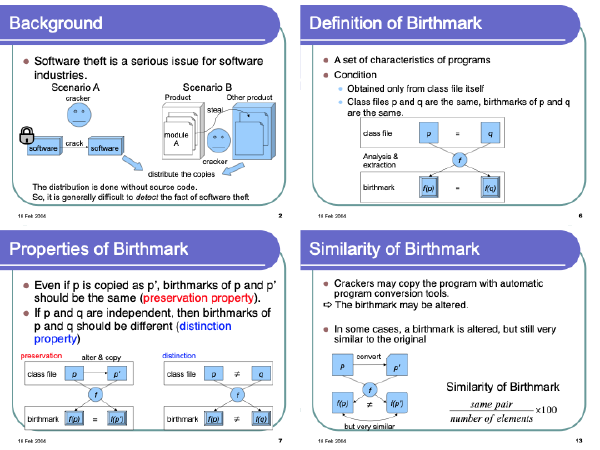
:speaking_head: Overview # To detect the theft of Java class files efficiently, we propose a concept of Java birthmarks, which are unique and native characteristics of every class file. For a pair of class files $p$ and $q$, if $q$ has the same birthmark as $p$’s, $q$ is suspected as a copy of $p$. Ideally, the birthmarks should satisfy the following properties: (a) preservation – the birthmarks should be preserved even if the original class file is tampered with, and (b) distinction – independent class files must be distinguished by completely different birthmarks. Taking (a) and (b) into account, we propose four types of birthmarks for Java class files.